
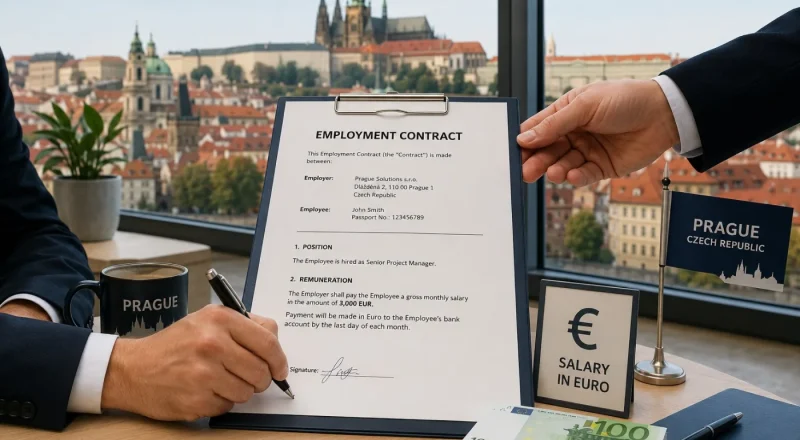
For foreign managers and highly qualified professionals working in the Czech Republic, the issue of receiving wages in a foreign currency (e.g., EUR or USD) has long been administratively complex. However, thanks to recent legislative changes—the so-called “Flexibility Amendment” to the Labour Code—this process is now much more accessible and reflects the needs of the modern international labour market.
If you are considering negotiating your salary in a currency other than the Czech koruna, here is an overview of the key aspects you should know.
New Rules for Foreign Currency Wages
Recent amendments to the Labour Code provide greater legal certainty for negotiating wages in foreign currencies for specific groups of employees (including expats with international ties). The key rules are as follows:
- Contractual Freedom: The law now explicitly allows for wages to be agreed upon in a foreign currency, provided it is mutually beneficial and supported by a valid employment contract.
- Currency Transparency: When paying wages in a foreign currency, it is necessary to use exchange rates published by the Czech National Bank. Although the salary is agreed upon in a foreign currency, all mandatory contributions (social security, health insurance, and personal income tax) must always be reported and paid in CZK within the Czech Republic.
- Adherence to Minimum Wage: The agreed wage must never be lower than the current minimum wage established by the Czech legal system.
The Minimum Wage in 2026
For 2026, the minimum wage is set at 22,400 CZK per month (based on a 40-hour work week).
It is crucial to highlight two key points:
- Abolition of Guaranteed Wages: As of January 1, 2025, the institution of “guaranteed wages” was entirely abolished in the private sector (for employees in employment relationships). Previously, wages had to correspond to the complexity and responsibility of the work performed. Now, private-sector employers are not bound by these categories, and the only “floor” remains the minimum wage. (Note: The concept of “guaranteed salary” remains in effect only for the state and public sector.)
- Automatic Indexation: The minimum wage is no longer subject to annual political negotiation but is governed by an automatic indexation mechanism. The goal is for it to reach 47% of the average national wage by 2029, ensuring greater predictability for both employees and companies.
Why Opt for a Foreign Currency Salary?
For expats, this amendment primarily brings the elimination of exchange rate risk. Managers who have financial obligations (e.g., mortgages, investments, or family expenses) primarily in Euros or Dollars can now better plan their personal finances without worrying about the volatility of the CZK exchange rate against their home currency.
Do You Need Legal Assistance in Labour Law?
Navigating Czech labour law, especially in the context of changing compensation rules and tax obligations, can be complex.
At MACH LEGAL, we understand that proper legal structuring of employment conditions is the key to successfully integrating international talent into the Czech market. Our specialized legal aid for expats is provided by a dedicated desk led by Dr. Eliška Fischerová.
Whether you are reviewing your employment contract, addressing questions related to foreign currency salary payments, or dealing with any other aspect of labour law, we are fully at your disposal.
Do you have a specific question about your employment contract or do you need assistance in negotiations with your employer? Please do not hesitate to reach out to Dr. Eliška Fischerová’s expert team at MACH LEGAL.
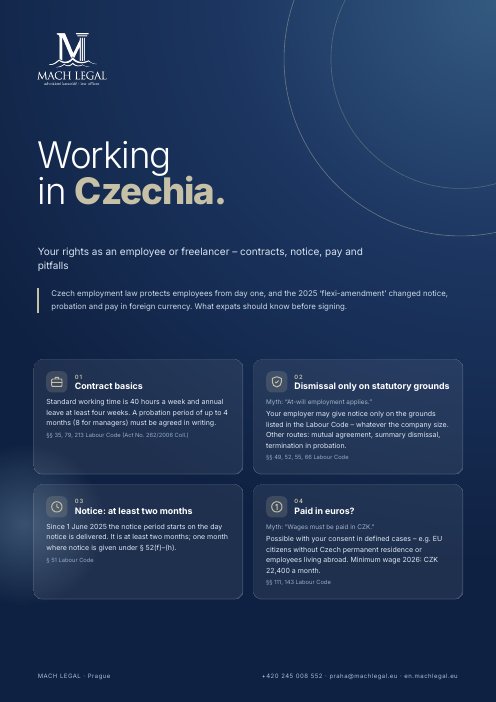
Free guide: Working in Czechia
Your rights as an employee or freelancer – contracts, notice, pay and pitfalls. PDF, 2 pages.
Download the guide (PDF)